Archive for January 2014
1.4 Planning, Organizing, Leading, and Controlling
1.4 Planning, Organizing, Leading, and Controlling
LEARNING OBJECTIVES
- Know the dimensions of the planning-organizing-leading-controlling (P-O-L-C) framework.
- Know the general inputs into each P-O-L-C dimension.
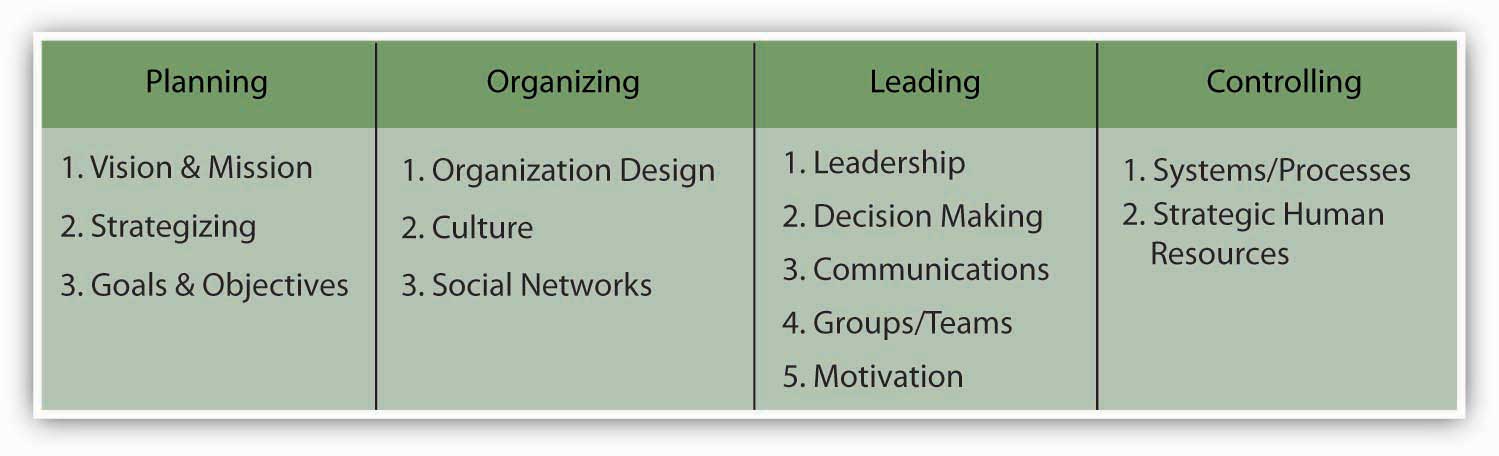
A manager’s primary challenge is to solve problems creatively. While drawing from a variety of academic disciplines, and to help managers respond to the challenge of creative problem solving, principles of management have long been categorized into the four major functions of planning, organizing, leading, and controlling (the P-O-L-C framework). The four functions, summarized in the P-O-L-C figure, are actually highly integrated when carried out in the day-to-day realities of running an organization. Therefore, you should not get caught up in trying to analyze and understand a complete, clear rationale for categorizing skills and practices that compose the whole of the P-O-L-C framework.
It is important to note that this framework is not without criticism. Specifically, these criticisms stem from the observation that the P-O-L-C functions might be ideal but that they do not accurately depict the day-to-day actions of actual managers. [1] The typical day in the life of a manager at any level can be fragmented and hectic, with the constant threat of having priorities dictated by the law of the trivial many and important few (i.e., the 80/20 rule). However, the general conclusion seems to be that the P-O-L-C functions of management still provide a very useful way of classifying the activities managers engage in as they attempt to achieve organizational goals. [2]
Figure 1.7 The P-O-L-C Framework
Planning
Planning is the function of management that involves setting objectives and determining a course of action for achieving those objectives. Planning requires that managers be aware of environmental conditions facing their organization and forecast future conditions. It also requires that managers be good decision makers.
Planning is a process consisting of several steps. The process begins with environmental scanning which simply means that planners must be aware of the critical contingencies facing their organization in terms of economic conditions, their competitors, and their customers. Planners must then attempt to forecast future conditions. These forecasts form the basis for planning.
Planners must establish objectives, which are statements of what needs to be achieved and when. Planners must then identify alternative courses of action for achieving objectives. After evaluating the various alternatives, planners must make decisions about the best courses of action for achieving objectives. They must then formulate necessary steps and ensure effective implementation of plans. Finally, planners must constantly evaluate the success of their plans and take corrective action when necessary.
There are many different types of plans and planning.
Strategic planning involves analyzing competitive opportunities and threats, as well as the strengths and weaknesses of the organization, and then determining how to position the organization to compete effectively in their environment. Strategic planning has a long time frame, often three years or more. Strategic planning generally includes the entire organization and includes formulation of objectives. Strategic planning is often based on the organization’s mission, which is its fundamental reason for existence. An organization’s top management most often conducts strategic planning.
Tactical planning is intermediate-range (one to three years) planning that is designed to develop relatively concrete and specific means to implement the strategic plan. Middle-level managers often engage in tactical planning.
Operational planning generally assumes the existence of organization-wide or subunit goals and objectives and specifies ways to achieve them. Operational planning is short-range (less than a year) planning that is designed to develop specific action steps that support the strategic and tactical plans.
Organizing
Organizing is the function of management that involves developing an organizational structure and allocating human resources to ensure the accomplishment of objectives. The structure of the organization is the framework within which effort is coordinated. The structure is usually represented by an organization chart, which provides a graphic representation of the chain of command within an organization. Decisions made about the structure of an organization are generally referred to as organizational design decisions.
Organizing also involves the design of individual jobs within the organization. Decisions must be made about the duties and responsibilities of individual jobs, as well as the manner in which the duties should be carried out. Decisions made about the nature of jobs within the organization are generally called “job design” decisions.
Organizing at the level of the organization involves deciding how best to departmentalize, or cluster, jobs into departments to coordinate effort effectively. There are many different ways to departmentalize, including organizing by function, product, geography, or customer. Many larger organizations use multiple methods of departmentalization.
Organizing at the level of a particular job involves how best to design individual jobs to most effectively use human resources. Traditionally, job designwas based on principles of division of labor and specialization, which assumed that the more narrow the job content, the more proficient the individual performing the job could become. However, experience has shown that it is possible for jobs to become too narrow and specialized. For example, how would you like to screw lids on jars one day after another, as you might have done many decades ago if you worked in company that made and sold jellies and jams? When this happens, negative outcomes result, including decreased job satisfaction and organizational commitment, increased absenteeism, and turnover.
Recently, many organizations have attempted to strike a balance between the need for worker specialization and the need for workers to have jobs that entail variety and autonomy. Many jobs are now designed based on such principles as empowerment, job enrichment and teamwork. For example, HUI Manufacturing, a custom sheet metal fabricator, has done away with traditional “departments” to focus on listening and responding to customer needs. From company-wide meetings to team huddles, HUI employees know and understand their customers and how HUI might service them best. [3]
Leading
Leading involves the social and informal sources of influence that you use to inspire action taken by others. If managers are effective leaders, their subordinates will be enthusiastic about exerting effort to attain organizational objectives.
The behavioral sciences have made many contributions to understanding this function of management. Personality research and studies of job attitudes provide important information as to how managers can most effectively lead subordinates. For example, this research tells us that to become effective at leading, managers must first understand their subordinates’ personalities, values, attitudes, and emotions.
Studies of motivation and motivation theory provide important information about the ways in which workers can be energized to put forth productive effort. Studies of communication provide direction as to how managers can effectively and persuasively communicate. Studies of leadership and leadership style provide information regarding questions, such as, “What makes a manager a good leader?” and “In what situations are certain leadership styles most appropriate and effective?”
Figure 1.8

Quality control ensures that the organization delivers on its promises.
© 2010 Jupiterimages Corporation
Controlling
Controlling involves ensuring that performance does not deviate from standards. Controlling consists of three steps, which include (1) establishing performance standards, (2) comparing actual performance against standards, and (3) taking corrective action when necessary. Performance standards are often stated in monetary terms such as revenue, costs, or profits but may also be stated in other terms, such as units produced, number of defective products, or levels of quality or customer service.
The measurement of performance can be done in several ways, depending on the performance standards, including financial statements, sales reports, production results, customer satisfaction, and formal performance appraisals. Managers at all levels engage in the managerial function of controlling to some degree.
The managerial function of controlling should not be confused with control in the behavioral or manipulative sense. This function does not imply that managers should attempt to control or to manipulate the personalities, values, attitudes, or emotions of their subordinates. Instead, this function of management concerns the manager’s role in taking necessary actions to ensure that the work-related activities of subordinates are consistent with and contributing toward the accomplishment of organizational and departmental objectives.
Effective controlling requires the existence of plans, since planning provides the necessary performance standards or objectives. Controlling also requires a clear understanding of where responsibility for deviations from standards lies. Two traditional control techniques are budget and performance audits. An audit involves an examination and verification of records and supporting documents. A budget audit provides information about where the organization is with respect to what was planned or budgeted for, whereas a performance audit might try to determine whether the figures reported are a reflection of actual performance. Although controlling is often thought of in terms of financial criteria, managers must also control production and operations processes, procedures for delivery of services, compliance with company policies, and many other activities within the organization.
The management functions of planning, organizing, leading, and controlling are widely considered to be the best means of describing the manager’s job, as well as the best way to classify accumulated knowledge about the study of management. Although there have been tremendous changes in the environment faced by managers and the tools used by managers to perform their roles, managers still perform these essential functions.
KEY TAKEAWAY
The principles of management can be distilled down to four critical functions. These functions are planning, organizing, leading, and controlling. This P-O-L-C framework provides useful guidance into what the ideal job of a manager should look like.
EXERCISES
- What are the management functions that comprise the P-O-L-C framework?
- Are there any criticisms of this framework?
- What function does planning serve?
- What function does organizing serve?
- What function does leading serve?
- What function does controlling serve?
source : http://catalog.flatworldknowledge.com
©2013 Flat World Knowledge, Inc. Terms of Use
INFORMATION RETRIEVAL
INFORMATION RETRIEVAL
A book byC. J. van RIJSBERGEN B.Sc., Dip. NAAC, Ph.D., M.B.C.S., F.I.E.E., C.Eng., F.R.S.E.
Information Retrieval Group, University of Glasgow
PREFACE TO THE SECOND EDITION (London: Butterworths, 1979)
The major change in the second edition of this book is the addition of a new chapter on probabilistic retrieval. This chapter has been included because I think this is one of the most interesting and active areas of research in information retrieval. There are still many problems to be solved so I hope that this particular chapter will be of some help to those who want to advance the state of knowledge in this area. All the other chapters have been updated by including some of the more recent work on the topics covered. In preparing this new edition I have benefited from discussions with Bruce Croft, David Harper, Stephen Robertson and Karen Sparck Jones. I am grateful to the University of Cambridge Computer Laboratory for providing me with the facilities for carrying out the work. Finally, I am indebted to the Royal Society for supporting me on their Scientific Information Research Fellowship.
PREFACE TO THE FIRST EDITION (London: Butterworths, 1975)
The material of this book is aimed at advanced undergraduate information (or computer) science students, postgraduate library science students, and research workers in the field of IR. Some of the chapters, particular chapter 6 (this became chapter 7 in the second edition), make simple use of a little advanced mathematics. However, the necessary mathematical tools can be easily mastered from numerous mathematical texts that now exist and, in any case, references have been given where the mathematics occur.
I had to face the problem of balancing clarity of exposition with density of references. I was tempted to give large numbers of references but was afraid they would have destroyed the continuity of the text. I have tried to steer a middle course and not compete with the Annual Review of Information Science and Technology.
Normally one is encouraged to cite only works that have been published in some readily accessible form, such as a book or periodical. Unfortunately, much of the interesting work in IR is contained in technical reports and Ph.D. theses. For example, most the work done on the SMART system at Cornell is available only in reports. Luckily many of these are now available through the National Technical Information Service (U.S.) and University Microfilms (U.K.). I have not avoided using these sources although if the same material is accessible more readily in some other form I have given it preference.
I should like to acknowledge my considerable debt to many people and institutions that have helped me. Let me say first that they are responsible for many of the ideas in this book but that only I wish to be held responsible. My greatest debt is to Karen Sparck Jones who taught me to research information retrieval as an experimental science. Nick Jardine and Robin Sibson taught me about the theory of automatic classification. Cyril Cleverdon is responsible for forcing me to think about evaluation. Mike Keen helped by providing data. Gerry Salton has influenced my thinking about IR considerably, mainly through his published work. Ken Moody had the knack of bailing me out when the going was rough and encouraging me to continue experimenting. Juliet Gundry is responsible for making the text more readable and clear. Bruce Croft, who read the final draft, made many useful comments. Ness Barry takes all the credit for preparing the manuscript. Finally, I am grateful to the Office of Scientific and Technical Information for funding most the early experimental work on which the book is based; to the King;s College Research Centre for providing me with an environment in which I could think, and to the Department of Information Science at Monash University for providing me with the facilities for writing.
C.J.v.R.
CONTENTS
   Preface

1. Introduction


2. Automatic Text Analysis


3. Automatic Classification


4. File Structures


5. Search Strategies


6. Probabilistic Retrieval


7. Evaluation


8. The Future


   Bibliography
The book is also available in Adobe Acrobat format
   Preface

1. Introduction


2. Automatic Text Analysis


3. Automatic Classification


4. File Structures


5. Search Strategies


6. Probabilistic Retrieval


7. Evaluation


8. The Future


source : http://www.dcs.gla.ac.uk


sour
C++ Tutorial
C++ Tutorial
C++ is a middle-level programming language developed by Bjarne
Stroustrup starting in 1979 at Bell Labs. C++ runs on a variety of
platforms, such as Windows, Mac OS, and the various versions of UNIX.
This reference will take you through simple and practical approach while learning C++ Programming language.
This reference will take you through simple and practical approach while learning C++ Programming language.
Audience
This reference has been prepared for the beginners to help them understand the basic to advanced concepts related to C++ Programming languages.Prerequisites
Before you start doing practice with various types of examples given in this reference, I'm making an assumption that you are already aware about what is a computer program and what is a computer programming language?Compile/Execute C++ Programs
For most of the examples given in this tutorial, you will find Try it option to compile and execute C++ programs online, so just make use of it and enjoy your learning.Try the following example using Try it option available at the top right corner of the below sample code box:
#include <iostream>
using namespace std;

int main()
{
   cout << "Hello World";
   return 0;
}
(1) C++ Basic Object Oriented Concepts
Just go through these concepts to understand basic Object Oriented Terminology.C++ Object Oriented Concepts
(2) C++ Quick Guide
A quick C++ reference guide for C++ Programmers.C++ Quick Guide
(3) C++ Useful Resources
A collection of C++ Sites, Books and Articles is given at this page.C++ Useful Resources
(4) C++ References
A link on C++ Standard LibraryC++ Standard Library
(5) C Tutorial
Learn C in really simple steps with examples using this tutorial.C Tutorial
(6) C++ Tutorial in PDF
Download a quick C++ tutorial in PDF format.C++ Tutorial in PDF
source : http://www.tutorialspoint.com/
Communications Server
Communications Server
Definition - What does Communications Server mean?
A communications server is a computing system platform that is used for various network communication applications and allows vendors to add multiple values at different levels of architecture.
A communications server is the foundation for equipment vendors or suppliers that build the network infrastructure used to deploy communication systems, such as wireless, broadband or IP-multimedia. The communications and IT industries are strong supporters of communications servers.
A communications server is the foundation for equipment vendors or suppliers that build the network infrastructure used to deploy communication systems, such as wireless, broadband or IP-multimedia. The communications and IT industries are strong supporters of communications servers.
Techopedia explains Communications Server
Communications servers include the following primary characteristics:
- Flexibility: Communications server architecture is scalable, multilevel, highly flexible, is designed to easily support added values at any level and has multiple server repurposing options.
- Openness: Communications servers are based on industry standards. Different tools and services may be further integrated on an as-needed basis.
- Carrier Grade: Communications server upgrades and updates are non-disruptive. Each associated system aspect and feature follows and fulfills network-building regulations.
There are many vendor-specific communications server alliances and communities that work toward the development of communications server systems.
Posted by: Cory Janssen
source : http://www.techopedia.com
How Safe Is Splenda (Sucralose)?
How Safe Is Splenda (Sucralose)?
Tuesday 25 June 2013 - 9am PST
Splenda (sucralose) is being downgraded from "safe" to "caution" after an Italian animal study linked sucralose to a higher risk of developing leukemia. The Center for Science in the Public Interest (CSPI) says it awaits the Italian study's review before deciding what long-term safety grade to assign to Splenda in its Chemical Cuisine guide to food additives.
Hundreds of millions of people globally use artificial sweeteners, which are commonly found in a wide range of food and drinks, including food for diabetes, cakes, milkshakes, soft drinks, and even medications.
The steadily growing problem of obesity and type 2 diabetes in developed and middle income countries has led to rising demand for reduced-calorie foods and drinks. However, the growth of the artificial-sweetener market has brought with it concerns among consumers regarding the potential health consequences.
Italian study linked a lifetime of sucralose consumption to leukemia risk
Dr. Morando Soffritti, director of the Ramazzini Institute in Bologna, Italy, and team fed 843 laboratory mice varying doses of sucralose from when they were fetuses until they died.Post-mortems showed an association between leukemia risk and lifetime sucralose consumption - the more sucralose they consumed, the higher their risk of leukemia.
Dr Soffritti said:
"Our early studies in rats showed increases in several types of cancer, and, in our most recent aspartame studies, we observed a statistically significant increase of liver and lung tumors in male mice. This shows aspartame causes cancer in various places of the body in two different species. Health concerns over aspartame are leading consumers to switch to the widely promoted alternative: sucralose.
Now that we have found evidence of a link between sucralose and cancer in mice, similar research should be urgently repeated on rats, and large scale observational studies should be set up to monitor any potential cancer risk to human health."
Dr Soffritti says that children and pregnant mothers should avoid consuming artificial sweeteners until appropriate studies clearly show there is no cancer risk.
On an online communiqué, CSPI added that the only long-term feeding studies on sucralose in animals, before the Italian one, were conducted by Johnson & Johnson, the makers of Splenda.
As things stand at the moment, these are the gradings CSPI gives to artificial sweeteners:
- Splenda - caution
- Saccharin - avoid
- Aspartame - avoid
- Acesulfame potassium - avoid
- Rebiana - safe
CSPI executive director Michael F. Jacobson, said:
"Sucralose may prove to be safer than saccharin, aspartame, and acesulfame potassium, but the forthcoming Italian study warrants careful scrutiny before we can be confident that the sweetener is safe for use in food."
Diet sodas probably still better than regular ones
Even though concerns exist regarding the health risks associated with artificial sweeteners, CSPI believespeople are better off drinking diet rather than regular sugar-sweetened sodas. The CSPI says that the health consequences from regularly drinking sugar-laden soft drinks, which include obesity, gout, tooth decay, heart disease, and type 2 diabetes, are probably greater.Water is best - soft drinks with any kind of natural or artificial sweetener commonly contain food dyes and caramel coloring that are contaminated with 4-methylimidazole, a carcinogen. CSPI encourages consumers to drink water, seltzer water (soda water, effervescent mineral water), flavored unsweetened waters, unsweetened iced tea, or seltzer mixed with natural fruit juice.
New sweeteners enter CSPI's Chemical Cuisine guide
CSPI has included some new natural sweeteners in its Chemical Cuisine guide:- Monkfruit extract (also known as Luo Han Guo or Lo Han Kuo) - contains mogrosides. Mogrosides are 200 times sweeter than sugar. However, they can leave a licorice-like aftertaste. Monkfruit extract currently has a "caution" rating because it has not been tested scientifically.
- Monatin - derived from a South African shrub. Monatin is said to be 3,000 times sweeter than sugar. Monatin currently has a "caution" rating because it has not been tested scientifically.
Written by Christian Nordqvist
Copyright: Medical News Today
Not to be reproduced without the permission of Medical News Today.
Not to be reproduced without the permission of Medical News Today.
source : http://www.medicalnewstoday.com
Bee Venom Destroys HIV And Spares Surrounding Cells
Bee Venom Destroys HIV And Spares Surrounding Cells
Monday 11 March 2013 - 12am PS
Melittin destroys some viruses and malignant tumor cells
Melittin is a powerful toxin found in bee venom. It can poke holes in the protective viral envelope that surrounds the human immunodeficiency virus, as well as other viruses. Free melittin in large-enough quantities can cause considerable damage.Senior author, Samuel A. Wickline, MD, the J. Russell Hornsby Professor of Biomedical Sciences, has demonstrated that nanoparticles loaded with melittin have anti-cancer properties and have the capacity to killtumor cells. Linking bee venom with anticancer therapies is not new, in 2004 Croatian scientists reported in the Journal of the Science of Food and Agriculture that honey-bee products, including venom, could well have applications in cancer treatment and prevention.
Normal cells remain intact - the scientists showed that nanoparticles loaded with melittin do not harm normal, healthy cells. Protective bumpers were added to the nanoparticles surface, so that when they come into contact with normal cells (which tend to be much larger), the nanoparticles bounce off rather than attach themselves.

Scientists have discovered a powerful toxin in bee venom that could end up playing a crucial role in preventing the spread of HIV.
Hood explained "Melittin on the nanoparticles fuses with the viral envelope. The melittin forms little pore-like attack complexes and ruptures the envelope, stripping it off the virus."
While most anti-HIV medications work on inhibiting the virus' ability to replicate, this one attacks a vital part of its structure. The problem with attacking a pathogen's ability to replicate is that it does not stop it from starting an infection. Some HIV strains have found ways to circumvent replication-inhibiting drugs, and reproduce regardless.
Hood said:
"We are attacking an inherent physical property of HIV. Theoretically, there isn't any way for the virus to adapt to that. The virus has to have a protective coat, a double-layered membrane that covers the virus."
Melittin nanoparticles may prevent and treat existing HIV infections
Hood believes that the melittin-loaded nanoparticles have the potential for two types of therapies:- A vaginal gel to prevent the spread of HIV infection
- Therapy for existing HIV infections, particularly drug-resistant ones
Hood said "The basic particle that we are using in these experiments was developed many years ago as an artificial blood product. It didn't work very well for delivering oxygen, but it circulates safely in the body and gives us a nice platform that we can adapt to fight different kinds of infections."
Melittin attacks double-layered membranes indiscriminately, making it a potential for drug therapies beyond HIV infections. The hepatitis B and C viruses, among several others, rely on the same type of protective envelope and could be targeted and destroyed by administering melittin-loaded nanoparticles.
The gel also has the potential to target sperm, the researchers explained, making it a possible contraceptive medication. The study, however, did not look at contraception.
Hood said "We also are looking at this for couples where only one of the partners has HIV, and they want to have a baby. These particles by themselves are actually very safe for sperm, for the same reason they are safe for vaginal cells."
This study was carried out in cells in a laboratory environment. However, the nanoparticles are easy to produce - enough of them could easily be supplied for future human studies.
Recent research on HIV
Over the last few years, scientists have made strides in improving HIV/AIDS treatments and prevention strategies.Baby "functionally cured" of HIV infection - researchers from Johns Hopkins Children's Center, the University of Mississippi Medical Center and the University of Massachusetts Medical School reported that a baby who was administered antiretroviral therapy thirty hours after being born was "functionally cured". A functional cure means that there is no detectable viral replication after retroviral therapy has stopped.
Ramping up HIV antiretroviral treatments worth the extra cost - investigators from Harvard University, USA, reported that scaling up HIV antiretroviral treatment in a remote province of South Africa (KwaZulu-Natal) reduced the risk of transmitting HIV to sexual partners by 96%.
Written by Christian Nordqvist
Copyright: Medical News Today
Not to be reproduced without the permission of Medical News Today.
Not to be reproduced without the permission of Medical News Today.
source : http://www.medicalnewstoday.com
