Archive for 2014
How to Install Windows 8
How to Install Windows 8
Windows 8 is a newer version of Windows that contains a number of new and updated features, including an interface that can be used with touchscreen devices. After you purchase Windows 8, you'll have the ability to download the operating system, and install the program to your computer. Follow the steps outlined in this article to purchase, install, and set up Windows 8.Part 1 of 3: Purchase Windows 8-
1Navigate to the Sources section below this article and click on the Microsoft Windows link that contains the word "purchase" in the URL.Ad
-
2Navigate to the section entitled "Purchase Windows 8," and click on the link for "Buy Windows."
-
3Click on "Get Started" after the landing page loads. Your computer will install the Windows 8 Upgrade Assistant, which will walk you through purchasing Windows 8 for your computer.
-
4Follow the instructions and prompts provided by the Windows 8 Upgrade Assistant. The upgrade assistant will require you to enter your name and credit card information, and will provide you with a receipt and product key for Windows 8.
- Write down the product key, as you'll need this information at the time you install Windows 8.
-
5Click "Next" after the upgrade assistant has provided you with the product key. Windows 8 will then start downloading to your computer, and display the Windows 8 Setup Wizard.
Part 2 of 3: Install Windows 8-
1Click on "Install now" after the Windows 8 Setup Wizard appears on your screen.
-
2Enter the product key you were provided with at the time of your Windows 8 purchase.
-
3Click "Next."
-
4Review the Windows 8 license terms, then place a checkmark next to "I Accept the license terms."
-
5Click on the "Next" button.
-
6Select from "Upgrade" or "Custom" Installation. The upgrade option will allow you to keep all your current files, settings, and applications, whereas the custom option will only install Windows 8 without saving your data.
-
7Click "Install." Your computer will restart several times while it installs Windows 8, and will display the Setup Wizard after Windows 8 has been successfully installed.
-
1Select any color of your choice from the "Personalize" screen. The color you choose will be the designated color theme for Windows 8, and can be changed at any time.
-
2Enter a name for your computer below the field entitled "PC name."
-
3Click on "Next."
-
4Choose your current network settings from the "Settings" screen, then click "Next." You will be asked whether you are using a home or work network, or if you are using a public network.
-
5Sign in to your PC using a Microsoft account or local account. The Microsoft account option requires you to create or sign in with a Microsoft username and password. The local account option requires you to create a username and password to be used specifically for your personal account on the computer.
-
6Wait for the Windows 8 user interface to load. Your screen will now display a new series of Windows 8 icons, and your desktop can be accessed by clicking on the "Desktop" icon.
- source : "https://apiadvanceelitec-a.akamaihd.netAd
-


Management Information Systems (MIS)
Management Information Systems (MIS)
A management information system (MIS) is a computerized database of financial information organized and programmed in such a way that it produces regular reports on operations for every level of management in a company. It is usually also possible to obtain special reports from the system easily. The main purpose of the MIS is to give managers feedback about their own performance; top management can monitor the company as a whole. Information displayed by the MIS typically shows "actual" data over against "planned" results and results from a year before; thus it measures progress against goals. The MIS receives data from company units and functions. Some of the data are collected automatically from computer-linked check-out counters; others are keyed in at periodic intervals. Routine reports are preprogrammed and run at intervals or on demand while others are obtained using built-in query languages; display functions built into the system are used by managers to check on status at desk-side computers connected to the MIS by networks. Many sophisticated systems also monitor and display the performance of the company's stock.
ORIGINS AND EVOLUTION
The MIS represents the electronic automation of several different kinds of counting, tallying, record-keeping, and accounting techniques of which the by far oldest, of course, was the ledger on which the business owner kept track of his or her business. Automation emerged in the 1880s in the form of tabulating cards which could be sorted and counted. These were the punch-cards still remembered by many: they captured elements of information keyed in on punch-card machines; the cards were then processed by other machines some of which could print out results of tallies. Each card was the equivalent of what today would be called a database record, with different areas on the card treated as fields. World-famous IBM had its start in 1911; it was then called Computing-Tabulating-Recording Company. Before IBM there was C-T-R. Punch cards were used to keep time records and to record weights at scales. The U.S. Census used such cards to record and to manipulate its data as well. When the first computers emerged after World War II punch-card systems were used both as their front end (feeding them data and programs) and as their output (computers cut cards and other machines printed from these). Card systems did not entirely disappear until the 1970s. They were ultimately replaced by magnetic storage media (tape and disks). Computers using such storage media speeded up tallying; the computer introduced calculating functions. MIS developed as the most crucial accounting functions became computerized.
Waves of innovation spread the fundamental virtues of coherent information systems across all corporate functions and to all sizes of businesses in the 1970s, 80s, and 90s. Within companies major functional areas developed their own MIS capabilities; often these were not yet connected: engineering, manufacturing, and inventory systems developed side by side sometimes running on specialized hardware. Personal computers ("micros," PCs) appeared in the 70s and spread widely in the 80s. Some of these were used as free-standing "seeds" of MIS systems serving sales, marketing, and personnel systems, with summarized data from them transferred to the "mainframe." In the 1980s networked PCs appeared and developed into powerful systems in their own right in the 1990s in many companies displacing midsized and small computers. Equipped with powerful database engines, such networks were in turn organized for MIS purposes. Simultaneously, in the 90s, the World Wide Web came of age, morphed into the Internet with a visual interface, connecting all sorts of systems to one another.
Midway through the first decade of the 21st century the narrowly conceived idea of the MIS has become somewhat fuzzy. Management information systems, of course, are still doing their jobs, but their function is now one among many others that feed information to people in business to help them manage. Systems are available for computer assisted design and manufacturing (CAD-CAM); computers supervise industrial processes in power, chemicals, petrochemicals, pipelines, transport systems, etc. Systems manage and transfer money worldwide and communicate worldwide. Virtually all major administrative functions are supported by automated system. Many people now file their taxes over the Internet and have their refunds credited (or money owning deducted) from bank accounts automatically. MIS was thus the first major system of the Information Age. At present the initials IT are coming into universal use. "Information Technology" is now the category to designate any and all software-hardware-communications structures that today work like a virtual nervous system of society at all levels.
MIS AND SMALL BUSINESS
If MIS is defined as a computer-based coherent arrangement of information aiding the management function, a small business running even a single computer appropriately equipped and connected is operating a management information system. The term used to be restricted to large systems running on mainframes, but that dated concept is no longer meaningful. A medical practice with a single doctor running software for billing customers, scheduling appointments, connected by the Internet to a network of insurance companies, cross-linked to accounting software capable of cutting checks is de facto an MIS. In the same vein a small manufacturer's rep organization with three principals on the road and an administrative manager at the home office has an MIS system, that system becomes the link between all the parts. It can link to the inventory systems, handle accounting, and serves as the base of communications with each rep, each one carrying a laptop. Virtually all small businesses engaged in consulting, marketing, sales, research, communications, and other service industries have large computer networks on which they deploy substantial databases. MIS has come of age and has become an integral part of small business.
But while virtually every company now uses computers, not all have as yet undertaken the kind of integration described above. To take the last step, however, has become much easier—provided that good reasons are present for doing so. The motivation for organizing information better usually comes from disorder—ordering again what has already been ordered, and sitting in boxes somewhere, because the company controls its inventory poorly. Motivation may arise also from hearing about others who are exploiting some resource, like a customer list, while the owner's own list is in sixteen pieces all over the place. There are sometimes also reasons for not automating things too much: in modern times a business can grind to a dead halt because "the network is down."
Upgrading the information system usually begins by identifying some kind of a problem and then seeking a solution. In that process a knowledgeable resource-person brought in from the outside can provide a great deal of help. If the problem is over-stocking, for example, solving that problem will often become the starting point for a new information system touching on many other aspects of the business. The first question a consultant is likely to ask will concern how things are managed now. In the description of the process, the discovery of potential solutions will begin. It is usually a good idea to call on two or three service firms for initial consultations; these rarely cost any money. Once the owner feels comfortable with one of these vendors, the process can then be deepened.
The business owner has the option of buying various software packages for various problems and then gradually linking them into a system with the help of a value-added reseller (VAR) or a systems integrator. This solution is probably best for the small business with fewer than 50 employees. Larger companies may in addition also want to explore options offered by application services providers or management service providers (ASPs and MSPs respectively, collectively referred to as xSPs) in installing ERP systems and providing Web services. ASPs deliver high-end business applications to a user from a central web site. MSPs offer on-site or Web-based systems management services to a company. ERP stands for "enterprise resource planning," a class of systems that integrate manufacturing, purchasing, inventory management, and financial data into a single system with or without Web capabilities. ERPs are very popular with larger and midsized firms but were increasingly penetrating the small business sector as well in the mid-2000s.
BIBLIOGRAPHY
"History of IBM—1910s." IBM. Available from http://www03.ibm.com/ibm/history/history/decade_1910.html. Retrieved on 15 April 2006.
Laudon, Kenneth C., and Jane Price Laudon. Management Information Systems: Managing the Digital Firm. Prentice Hall, 2005.
"Learning Zone—MIS: Time to plunge into automated systems." Printing World. 6 April 2006.
Shim, Jae K. and Joel F. Siegel. The Vest Pocket Guide to Information Technology. John Wiley & Sons, 2005.
Torode, Christina. "xSPs Rethink Business Models." Computer Reseller News. 15 July 2002.
source : http://www.inc.com
Types of Technician Careers and Other High Paying Tech Careers
If you’ve been interested in pursuing a career as a technician, you’ll be happy to know that there are a wide variety of jobs available to you. The key to finding the right career option for you is exploring just what’s out there. Here is a brief list and then a little more in depth review at a few particular technician careers.
- Medical Technician Careers
- Lab Technician Careers
- Engineering Technician Careers
- Many, Many, more.
Automotive Technician Careers
There are a lot of great opportunities available to those looking for automotive technician careers. The specifications of these jobs vary but generally center around utilizing advanced computerized control systems and diagnostic equipment. Many automotive technicians also work to create various vehicle colors and styles, as well as adjust power and speed.
As a technician, you will be required to know computers, math and science. The types of careers you can take on in this field include auto detailing, auto service, diesel, motorcycle, NASCAR, and watercraft.
As a technician, you will be required to know computers, math and science. The types of careers you can take on in this field include auto detailing, auto service, diesel, motorcycle, NASCAR, and watercraft.
Aviation Technician Careers
Another career option that’s available to technician hopefuls is the aviation technician career. Slightly different than the automotive technician career, a technician involved in avionics inspects, tests, and repairs the electronic components of various navigation, communication and flight-control systems. Additionally, aviation technicians may work with engineers in an effort to develop and install new electronics systems. In order to take on this career, students will be required to complete two- or four-year training at a technical institute, community college, or university. Also, frequent seminar attendance and training is required to remain current in the field once employed. Some specific technician careers in avionics include airframe and power plant, avionics and maintenance.
Computer Technician Careers
Computer technician careers are among the highest in demand. Because most of the business world relies on computers for company networking, as well as Internet access, it becomes increasingly important that technicians are around to manage day-to-day activities. There are a number of computer technician job opportunities available, but in general this position handles a number of responsibilities, including installing, maintaining, and troubleshooting computer hardware and software, creating computer networks, setting up email accounts, providing technical training to employees, and recommending hardware/software acquisitions.
Educational requirements for these careers typically include two years of computer science/information technology coursework. Specific job options in this career cluster include network and repair technicians.
Medical Technician Careers
Like all of the other technician careers, medical technician careers are varied in responsibility. However, some basic job duties might include performing routine tests in clinical laboratories, collecting, storing and labeling specimens, tending automatic equipment, performing analytical tests, preparing solutions, and cleaning and sterilizing laboratory equipment. Pursuing a career as a medical technician requires completing a technician program and receiving certification by a nationally-recognized agency or board. Some medical technician jobs include dental, dialysis, pharmacy, patient, radiology, surgical, ultrasound, x-ray, and veterinary.
Choosing the type of technician career you would like to take on rests solely on your decision to pursue what makes you truly happy. So before you settle into a career choice in this field, take time to explore what you love, and how you really want to make a difference in the lives of others.
Other Top Tech Careers
Many of the most popular tech careers fall into the information technology field. This is because the Internet is so powerful and ever-evolving; there has to be a broad industry to keep up with its demands. As a result, some of the more popular tech careers include:
Database Administration – Those in this career are responsible for guaranteeing the security of information for employees and customers of business. They also have to guarantee the accessibility of this information. Individuals in this job require continuous technical training and usually require a bachelor’s degree and independent certification. Those who hire in this career often remark that they can fill these positions fast enough.
Computer Systems Analysis – This career type is responsible for digging deep into tools that will allow for solving major computing challenges. Those in this career usually need both hardware and software expertise; however, they are not categorized as designers, developers, or programmers. To enter this field, one usually needs a computer science degree that focuses more on academic research than programming skills.
Web Hosting Technician Jobs – Another popular tech career is the web hosting technician. Because the Internet has now become its own beast, web hosting technicians are now required for many business online promotional sites, photo libraries, applications, and much more. Many technicians also work directly for web hosting companies, ensuring that those sites operating from this company function properly. This career also requires software and hardware knowledge, as well as generator and security-system experience.
High-Paying Tech Careers
While we’re looking at popular technology careers, let’s also take a quick look at some of the higher-paying careers fond in the same industry.
Information Research Scientist – This high-tech career focuses on the research aspect of information technology and usually pays in the ballpark of $95,000 to $130,000 per year.
Systems Software Engineer – Individuals on this career track average a pay of $84,000 per year, with a cap in the area of $143,000.
Data Miner – Those in data mining are considered top-dollar computer programmers, and fall into the category of averaging $72,000 per year with the top 10-percent earning as much as $115,000 per year.
There are a number of other popular careers to take advantage of, but of course, in order to dive into those industries, you must first acquire the appropriate education. So learn all you can about the tech industries that interest you then enjoy your pursuit of the career of your dreams.
source : http://www.technicalschool.org
1.4 Planning, Organizing, Leading, and Controlling
1.4 Planning, Organizing, Leading, and Controlling
LEARNING OBJECTIVES
- Know the dimensions of the planning-organizing-leading-controlling (P-O-L-C) framework.
- Know the general inputs into each P-O-L-C dimension.
A manager’s primary challenge is to solve problems creatively. While drawing from a variety of academic disciplines, and to help managers respond to the challenge of creative problem solving, principles of management have long been categorized into the four major functions of planning, organizing, leading, and controlling (the P-O-L-C framework). The four functions, summarized in the P-O-L-C figure, are actually highly integrated when carried out in the day-to-day realities of running an organization. Therefore, you should not get caught up in trying to analyze and understand a complete, clear rationale for categorizing skills and practices that compose the whole of the P-O-L-C framework.
It is important to note that this framework is not without criticism. Specifically, these criticisms stem from the observation that the P-O-L-C functions might be ideal but that they do not accurately depict the day-to-day actions of actual managers. [1] The typical day in the life of a manager at any level can be fragmented and hectic, with the constant threat of having priorities dictated by the law of the trivial many and important few (i.e., the 80/20 rule). However, the general conclusion seems to be that the P-O-L-C functions of management still provide a very useful way of classifying the activities managers engage in as they attempt to achieve organizational goals. [2]
Figure 1.7 The P-O-L-C Framework
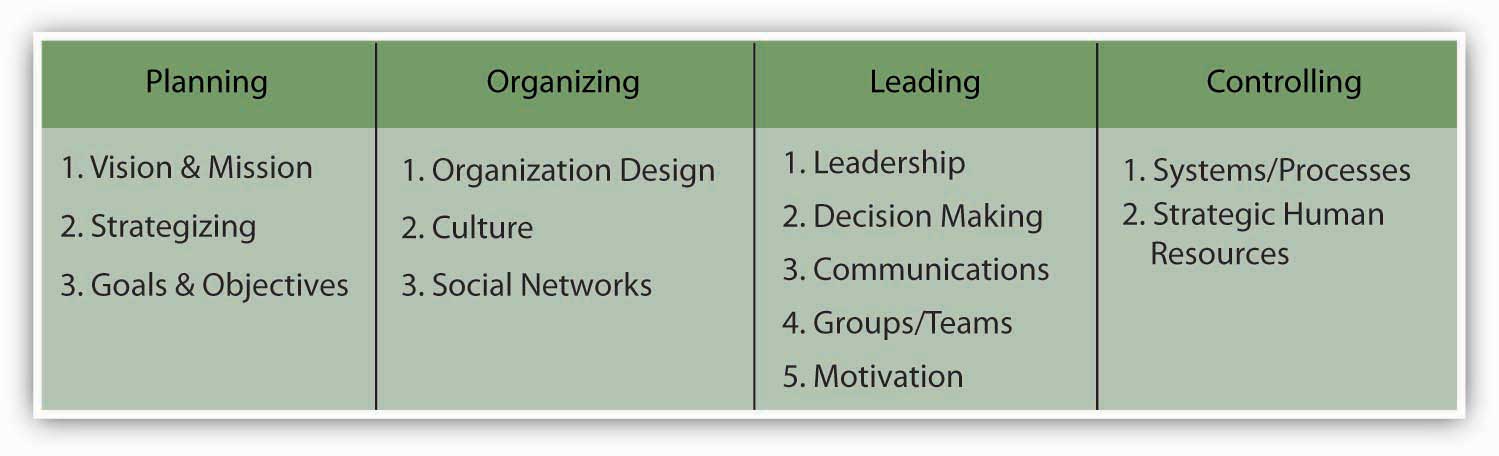
Planning
Planning is the function of management that involves setting objectives and determining a course of action for achieving those objectives. Planning requires that managers be aware of environmental conditions facing their organization and forecast future conditions. It also requires that managers be good decision makers.
Planning is a process consisting of several steps. The process begins with environmental scanning which simply means that planners must be aware of the critical contingencies facing their organization in terms of economic conditions, their competitors, and their customers. Planners must then attempt to forecast future conditions. These forecasts form the basis for planning.
Planners must establish objectives, which are statements of what needs to be achieved and when. Planners must then identify alternative courses of action for achieving objectives. After evaluating the various alternatives, planners must make decisions about the best courses of action for achieving objectives. They must then formulate necessary steps and ensure effective implementation of plans. Finally, planners must constantly evaluate the success of their plans and take corrective action when necessary.
There are many different types of plans and planning.
Strategic planning involves analyzing competitive opportunities and threats, as well as the strengths and weaknesses of the organization, and then determining how to position the organization to compete effectively in their environment. Strategic planning has a long time frame, often three years or more. Strategic planning generally includes the entire organization and includes formulation of objectives. Strategic planning is often based on the organization’s mission, which is its fundamental reason for existence. An organization’s top management most often conducts strategic planning.
Tactical planning is intermediate-range (one to three years) planning that is designed to develop relatively concrete and specific means to implement the strategic plan. Middle-level managers often engage in tactical planning.
Operational planning generally assumes the existence of organization-wide or subunit goals and objectives and specifies ways to achieve them. Operational planning is short-range (less than a year) planning that is designed to develop specific action steps that support the strategic and tactical plans.
Organizing
Organizing is the function of management that involves developing an organizational structure and allocating human resources to ensure the accomplishment of objectives. The structure of the organization is the framework within which effort is coordinated. The structure is usually represented by an organization chart, which provides a graphic representation of the chain of command within an organization. Decisions made about the structure of an organization are generally referred to as organizational design decisions.
Organizing also involves the design of individual jobs within the organization. Decisions must be made about the duties and responsibilities of individual jobs, as well as the manner in which the duties should be carried out. Decisions made about the nature of jobs within the organization are generally called “job design” decisions.
Organizing at the level of the organization involves deciding how best to departmentalize, or cluster, jobs into departments to coordinate effort effectively. There are many different ways to departmentalize, including organizing by function, product, geography, or customer. Many larger organizations use multiple methods of departmentalization.
Organizing at the level of a particular job involves how best to design individual jobs to most effectively use human resources. Traditionally, job designwas based on principles of division of labor and specialization, which assumed that the more narrow the job content, the more proficient the individual performing the job could become. However, experience has shown that it is possible for jobs to become too narrow and specialized. For example, how would you like to screw lids on jars one day after another, as you might have done many decades ago if you worked in company that made and sold jellies and jams? When this happens, negative outcomes result, including decreased job satisfaction and organizational commitment, increased absenteeism, and turnover.
Recently, many organizations have attempted to strike a balance between the need for worker specialization and the need for workers to have jobs that entail variety and autonomy. Many jobs are now designed based on such principles as empowerment, job enrichment and teamwork. For example, HUI Manufacturing, a custom sheet metal fabricator, has done away with traditional “departments” to focus on listening and responding to customer needs. From company-wide meetings to team huddles, HUI employees know and understand their customers and how HUI might service them best. [3]
Leading
Leading involves the social and informal sources of influence that you use to inspire action taken by others. If managers are effective leaders, their subordinates will be enthusiastic about exerting effort to attain organizational objectives.
The behavioral sciences have made many contributions to understanding this function of management. Personality research and studies of job attitudes provide important information as to how managers can most effectively lead subordinates. For example, this research tells us that to become effective at leading, managers must first understand their subordinates’ personalities, values, attitudes, and emotions.
Studies of motivation and motivation theory provide important information about the ways in which workers can be energized to put forth productive effort. Studies of communication provide direction as to how managers can effectively and persuasively communicate. Studies of leadership and leadership style provide information regarding questions, such as, “What makes a manager a good leader?” and “In what situations are certain leadership styles most appropriate and effective?”
Figure 1.8

Quality control ensures that the organization delivers on its promises.
© 2010 Jupiterimages Corporation
Controlling
Controlling involves ensuring that performance does not deviate from standards. Controlling consists of three steps, which include (1) establishing performance standards, (2) comparing actual performance against standards, and (3) taking corrective action when necessary. Performance standards are often stated in monetary terms such as revenue, costs, or profits but may also be stated in other terms, such as units produced, number of defective products, or levels of quality or customer service.
The measurement of performance can be done in several ways, depending on the performance standards, including financial statements, sales reports, production results, customer satisfaction, and formal performance appraisals. Managers at all levels engage in the managerial function of controlling to some degree.
The managerial function of controlling should not be confused with control in the behavioral or manipulative sense. This function does not imply that managers should attempt to control or to manipulate the personalities, values, attitudes, or emotions of their subordinates. Instead, this function of management concerns the manager’s role in taking necessary actions to ensure that the work-related activities of subordinates are consistent with and contributing toward the accomplishment of organizational and departmental objectives.
Effective controlling requires the existence of plans, since planning provides the necessary performance standards or objectives. Controlling also requires a clear understanding of where responsibility for deviations from standards lies. Two traditional control techniques are budget and performance audits. An audit involves an examination and verification of records and supporting documents. A budget audit provides information about where the organization is with respect to what was planned or budgeted for, whereas a performance audit might try to determine whether the figures reported are a reflection of actual performance. Although controlling is often thought of in terms of financial criteria, managers must also control production and operations processes, procedures for delivery of services, compliance with company policies, and many other activities within the organization.
The management functions of planning, organizing, leading, and controlling are widely considered to be the best means of describing the manager’s job, as well as the best way to classify accumulated knowledge about the study of management. Although there have been tremendous changes in the environment faced by managers and the tools used by managers to perform their roles, managers still perform these essential functions.
KEY TAKEAWAY
The principles of management can be distilled down to four critical functions. These functions are planning, organizing, leading, and controlling. This P-O-L-C framework provides useful guidance into what the ideal job of a manager should look like.
EXERCISES
- What are the management functions that comprise the P-O-L-C framework?
- Are there any criticisms of this framework?
- What function does planning serve?
- What function does organizing serve?
- What function does leading serve?
- What function does controlling serve?
source : http://catalog.flatworldknowledge.com
©2013 Flat World Knowledge, Inc. Terms of Use
